The Scale — Mountains We Can't See
292 million tons per year — and growing
- US Statistics:
- 292.4 million tons of municipal solid waste generated annually (2018 EPA data)
- 146.1 million tons ended up in landfills (50%)
- 1,600 pounds per person per year — that's 4.4 pounds per day
- Only 32% recycling rate nationally
- Sacramento County:
- 1.5 million tons of waste generated annually
- Roughly 750,000 tons landfilled each year
- Sacramento residents generate slightly above the national average
- The Kiefer Landfill processes ~3,000 tons per day
Every single day, Sacramento buries enough waste to fill a football field 10 feet deep. Nationally, we bury the equivalent of 80,000 garbage trucks worth of material daily.
Most shocking: 50-75% of what's in landfills could have been diverted through reuse, recycling, composting, or donation.
The Convenience Trap — Throwing Away Is the Default
Our systems are designed for disposal
- Why throwing things away is so easy:
- Trash cans are everywhere — in every room, on every corner
- Pickup is automatic — just set it on the curb
- No sorting required — everything goes in one bag
- No questions asked — throw it in, it disappears
- Why alternatives are harder:
- Recycling requires sorting, cleaning, rule-following
- Donation requires driving somewhere during business hours
- Repair shops are rare and often expensive
- Reuse takes creativity and effort
The design problem: Our infrastructure is optimized for disposal. Trash cans outnumber recycling bins 10:1 in most public spaces. Drop-off centers have limited hours. Repair culture has been replaced by "just buy new."
The psychological element: Throwing something away gives instant closure. It's gone. Alternatives require decisions: "Is this recyclable? Should I donate it? Can I fix it?" Decision fatigue makes people default to the easiest option.
Even people who care about waste end up landfilling because the system makes that the easiest choice.
The Knowledge Gap — "I Didn't Know That Was an Option"
- What people don't know:
- That mattresses and electronics can't go in regular trash (illegal in CA)
- That many "trash" items have significant resale value
- That textile recycling exists (30+ pounds of clothing per person per year gets trashed)
- That broken items can often be repaired for less than replacement cost
- That composting can divert 30% of household waste
- The information problem:
- Recycling rules change frequently and vary by location
- Special waste programs exist but aren't advertised
- People don't know where to take items for reuse
- Donation centers have opaque acceptance criteria
- Real examples:
- "I threw away my old couch" — furniture banks desperately need these
- "I trashed my broken laptop" — contains $10-30 in recoverable materials
- "I didn't know you could recycle clothes" — H&M, Goodwill, and others take textiles in any condition
- "My city recycles Styrofoam?" — Some do (at special facilities), most don't
Sacramento has 17 different drop-off programs for specialized items — but how many residents know about them? If people had one place to check routing for any item, the knowledge gap shrinks dramatically.
The Infrastructure Problem — Recycling Systems Are Confusing and Broken
When the system fails, people give up
- Why recycling feels broken:
- Inconsistent rules: Plastic bags accepted in one city, banned in another
- Contamination rejections: One greasy pizza box ruins an entire truckload
- Changing markets: China's 2018 import ban crashed US recycling overnight
- Misleading symbols: The chasing arrows triangle doesn't mean "recyclable"
- No feedback loop: You put it in the bin… then what? No one knows.
- Sacramento's challenges:
- Accepts #1, #2, #5 plastics — but not all shapes (no bags, films, or tanglers)
- Glass is technically recyclable but often rejected due to contamination
- Cardboard accepted unless it's wax-coated, greasy, or wet
- Residents have no way to verify if their recycling was actually recycled
The sorting problem: Modern recycling uses automated optical sorters and magnets. Items that are too small (under 2 inches), wrong shape (plastic bags, tanglers), contaminated (food residue), or mixed materials (shoes, toys) get rejected and sent to landfill *even though you put them in the recycling bin.*
The trust crisis: When people learn their recycling might end up in landfills anyway, many stop trying. US recycling rate has plateaued at 32% for a decade.
The Cost Myth — "Disposal Is Cheaper" (But Is It?)
The hidden price of "cheap" trash
- What it costs to landfill (apparent cost):
- Sacramento: $35-50 per ton tipping fee
- Residential pickup: Built into taxes/monthly bill
- Feels "free" to the consumer
- What it costs to landfill (real cost):
- Land use: 1,600+ acres for Kiefer Landfill alone
- Methane emissions: Landfills are 3rd largest source of human-caused methane in US
- Leachate management: Toxic liquid requires treatment for 30+ years after closure
- Lost material value: Buried resources can't be recovered
- Transportation emissions: Hauling waste averages 50+ miles
- Future liability: Closed landfills require monitoring for generations
- What we lose by burying:
- Metals worth $10-30 per device in e-waste
- Textiles that could be resold or recycled into insulation
- Organics that could become compost
- Plastics that could be feedstock for new products
Landfilling costs $50/ton upfront but thousands in long-term costs. Reuse and recycling cost more upfront but create economic value and jobs while avoiding future liability. We socialize the cost and privatize the convenience.
The Visibility Problem — Out of Sight, Out of Mind
We don't see where our trash goes
- The disappearance act:
- You throw something in the trash
- You take the bag to the curb
- A truck picks it up
- It's gone from your life forever
Most people have never been to a landfill. Waste facilities are deliberately located far from residential areas. Pickup happens early morning when people aren't watching. There's no feedback — no report card on your waste.
Your trash travels an average of 50 miles to the landfill. In Sacramento, it goes to Kiefer Landfill in Sloughhouse (25 miles from downtown). You'll probably never drive past it.
The problem with invisibility: When consequences are invisible, behavior doesn't change. If every household had to drive their trash to the landfill themselves and watch it get buried, waste would drop dramatically.
- Compare to other problems:
- Dirty dishes pile up in your sink — you wash them
- Clutter fills your garage — you organize it
- But trash disappears — you never confront it
Once it's on the curb, it's the city's problem. Once it's in the truck, it's the landfill's problem. Upcycle's counter-approach: make routing visible, show people where items *could* go, create transparency about the path each object takes.
What Actually Happens at a Landfill — The Reality
Burial, compaction, and 300 years of waiting
- The landfill process:
- Arrival: Trucks dump waste in the active cell
- Compaction: Bulldozers crush and compact waste to reduce volume
- Daily cover: 6 inches of soil spread over trash each day (to control odor, pests, fire)
- Layering: Repeat daily. Build up in layers.
- Capping: When full, seal with clay and synthetic liner
- Monitoring: Required for 30+ years minimum after closure
What's inside: 25% paper/cardboard, 22% food waste, 18% plastics, 12% yard trimmings, 9% metals, 8% textiles, 6% other (glass, electronics, etc.)
The decomposition myth: People assume trash "decomposes" in landfills. It doesn't — not really. Landfills are anaerobic (no oxygen). Newspapers from the 1960s are still readable when excavated. Hot dogs stay intact for decades. Biodegradable items don't biodegrade without oxygen.
Sacramento's Kiefer Landfill: Opened 1996, expected closure 2050-2060, post-closure monitoring required until 2090+ minimum. Your trash will outlive you.
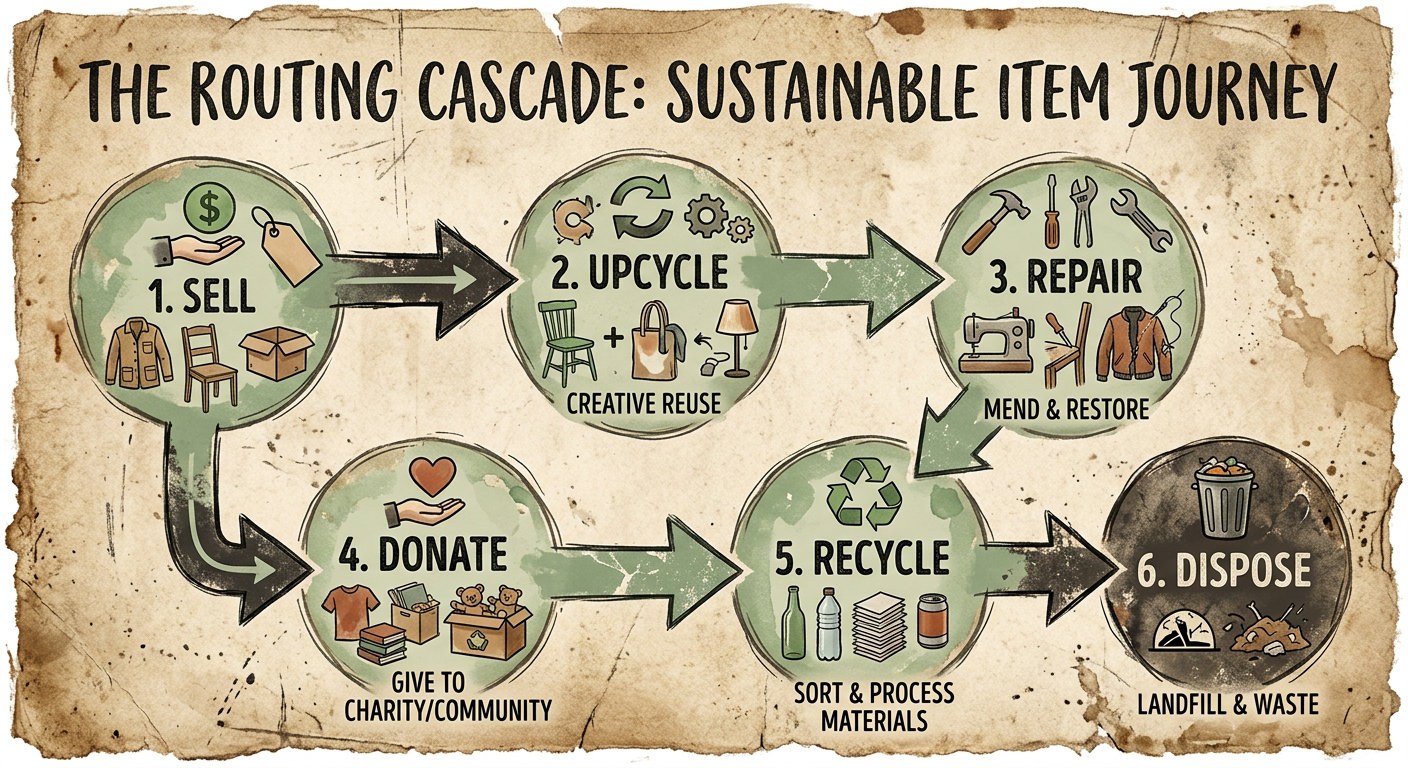
The Alternative Path — Upcycle's Routing Cascade
What if throwing away wasn't the default?
Instead of one destination (landfill), every item gets evaluated through multiple pathways:
1. Reuse (highest value) — Can someone else use this as-is? Donation, resale, gifting, swapping. Keeps item in use without reprocessing.
2. Repair/Refurbish — Can this be fixed and used again? Repair cafes, service centers, DIY guides. Extends product life, reduces waste.
3. Upcycle/Repurpose — Can this become something else of equal or higher value? Creative reuse, material transformation.
4. Recycle — Can the materials be reprocessed into new products? Traditional recycling, specialized facilities.
5. Compost/Energy Recovery — Can organic material become soil or energy? Lowest value recovery, but still better than burial.
6. Landfill (last resort) — Only after all other options exhausted. Truly non-recoverable items only.
Why this works: The user doesn't need to know all the rules — the system does. It finds the best local option automatically, shows where the item goes and why, and connects donors, repair shops, recyclers, and upcyclers in one ecosystem. Landfill becomes the exception, not the default.