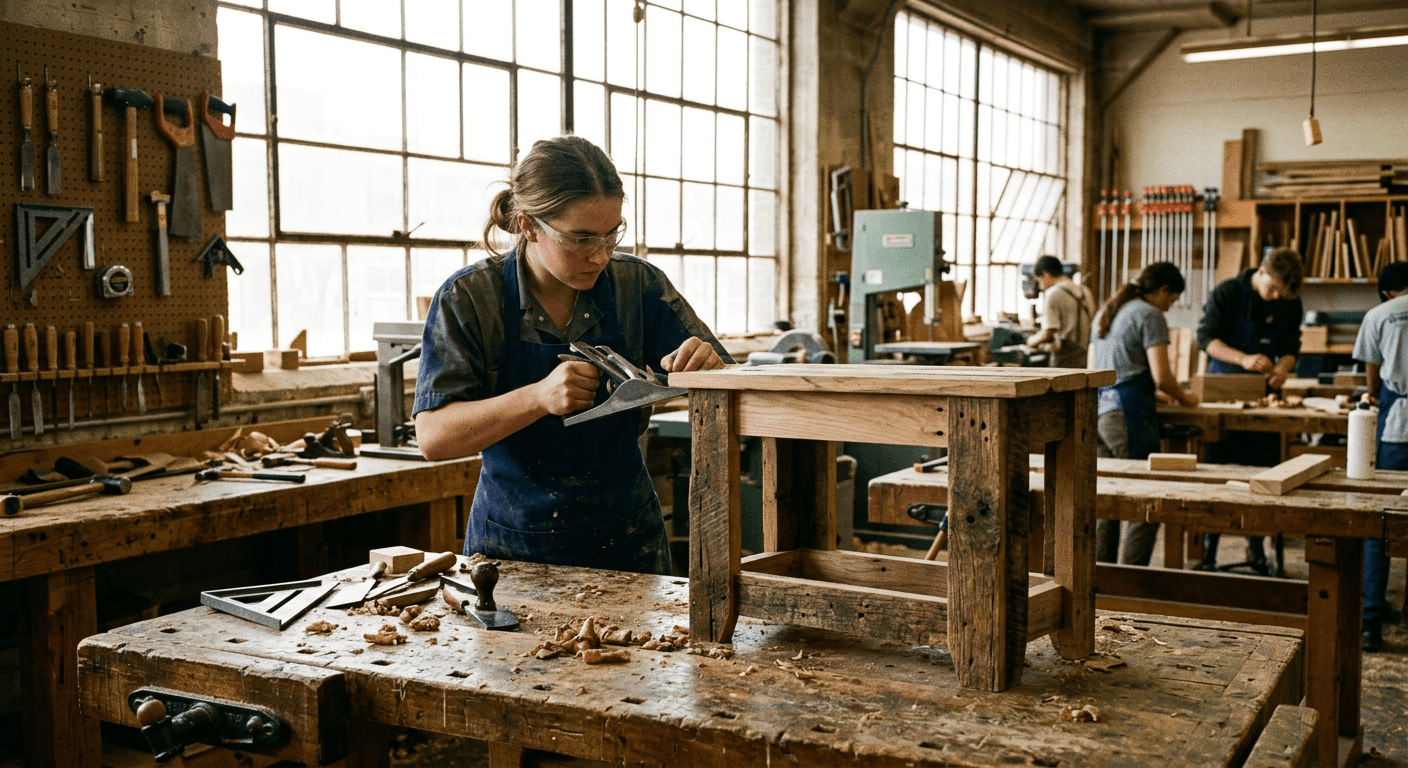
The table stops people mid-sentence. Eight feet of glowing warmth, its surface a mosaic of oak and walnut planks pulled from a demolished Philadelphia row house. The joinery is precise. The finish is flawless. And the young woman who built it — twenty-two years old, fresh out of a two-year carpentry program — talks about it the way a sculptor talks about marble.
She describes reading the grain, working around nail holes, letting the imperfections guide the design rather than fighting them. Her instructor calls it one of the best student pieces he has seen in fifteen years. The table earned her top marks, a small write-up in the school newsletter, and a genuine career-launching portfolio piece.
Six months later, she is building with virgin lumber. Not because she wants to. Because she has no reliable way to find reclaimed wood.
The Quiet Contradiction
This is the quiet contradiction at the heart of sustainable vocational education. The classroom works. The skills transfer. The pedagogy is sound. But the moment graduates leave the shop and enter the market, they discover that the material streams which fed their training simply do not exist in any accessible, organized form.
The routing layer — the connective tissue between industrial surplus and skilled hands — is missing. And until it is built, even the best-trained upcyclers will default to new materials, not out of preference, but out of necessity.
The Classroom Works
Career and technical education programs across the country have been quietly proving something that traditional academic institutions have struggled to articulate: sustainability is not an abstract principle. It is a craft skill.
Over the past decade, CTE programs in carpentry, welding, textiles, and industrial design have increasingly incorporated reclaimed and surplus materials into their curricula. The reasons are partly economic — salvaged materials cost less, which matters when budgets are tight — but the pedagogical benefits have turned out to be far more significant than the savings.
Working with reclaimed materials forces adaptability. A student handed a stack of uniform two-by-fours learns to measure, cut, and join. A student handed a pile of mismatched barn boards learns all of that plus material assessment, creative problem-solving, structural improvisation, and the kind of hands-on judgment that no textbook can teach.
A 2024 study from the National Center for Construction Education and Research found that students in programs incorporating at least 40 percent reclaimed materials scored higher on practical assessments — problem-solving metrics were 18 percent higher, and material waste dropped by nearly a third.
After Graduation, the Stream Runs Dry
The carpentry student with the stunning table had an advantage her program could provide: a steady supply of reclaimed wood. Her school had relationships with local demolition contractors. It maintained a material library. Instructors spent years cultivating donation pipelines from manufacturers offloading defective stock.